Official PLAN Statement on Artificial Intelligence Use on Campuses
September 14, 2026
The field of Artificial Intelligence (AI) has boomed in recent years, and many zero waste programs are beginning to adopt AI tools as part of their base operations.
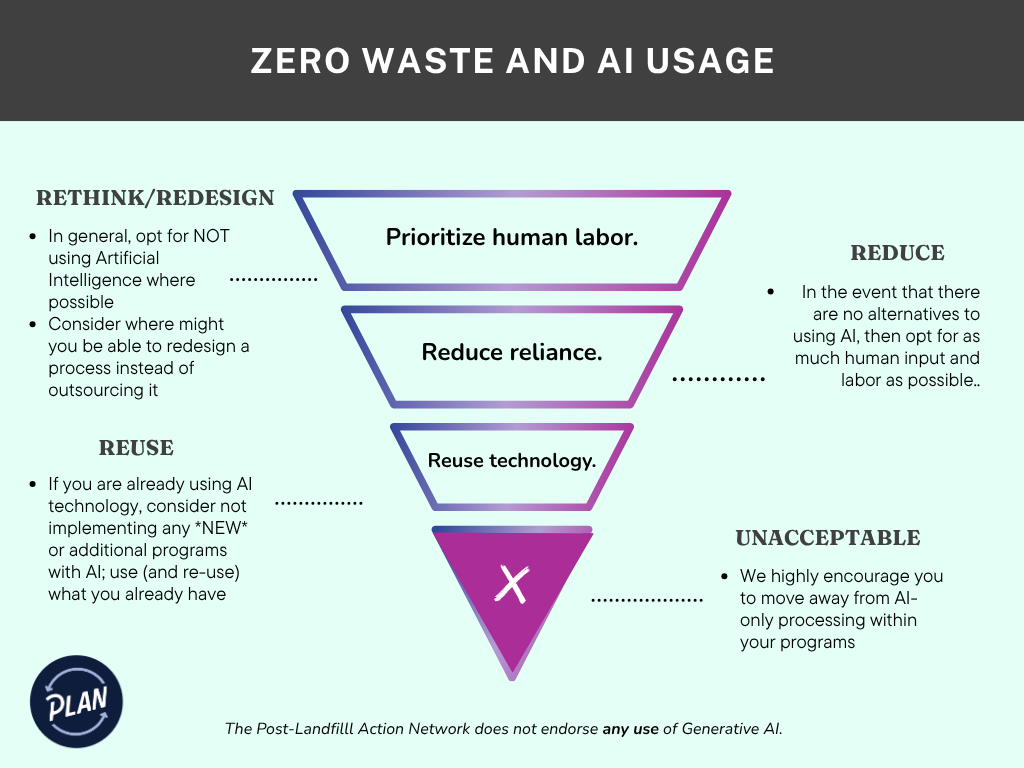
As an organization, the Post-Landfill Action Network (PLAN) does not support the use of Generative AI within our work, which can be defined as any learning model that repurposes text and images in order to generate its own content (source). An example of Generative AI is a piece of artwork that was created using online data, but not created by a human, such as a waste bin photograph that was created by ChatGPT. Generative AI is distinguished from Agentic AI. Agentic AI can be defined as an autonomous, goal-oriented version of AI that learns from human content in order to produce a particular result (source). An example might be a Customer Service Support Chat, with automated pathways towards specific answers to common prompts/questions. As thought leaders within the Zero Waste Movement, we also offer the below graphic to help campuses identify best practices for using AI within a campus environment, whether it is something that you have already adopted or something you have been curious about implementing.
Overall, PLAN holds the stance to reduce reliance on AI because we recognize that the pursuit of making something “easier” can often instead lead to human job loss, lack of leadership transition and problem-solving capability, data security breaches, environmental hazards, and malfunctioning technology. That said, if you understand these risks or already use AI and would like to know how to use AI more responsibly in your zero-waste programming, that is an option.
Graphic Description: An upside-down triangle is depicted below. Modeled after the Zero Waste Hierarchy (image here), the purpose is to “describe a progression of policies and strategies to support the zero waste system, from highest and best to lowest use of materials”.
An upside down triangle displaying the principles of redesign, reduce, and reuse when it comes to AI in zero waste work.
Prioritize Human Labor: We begin with Rethink/Redesign at the top, where we strongly encourage prioritizing Human Labor and Intelligence whenever possible in your zero-waste programs. Something to consider at this stage is where you might be able to redesign a process instead of outsourcing it. Within this step, you are encouraged to think about what challenges may exist within your campus systems, and how to adjust capacity or contribute to knowledge-sharing, instead of defaulting to automation. Examples of alternative-to-AI solutions include the following
AI note-takers → Instead of using AI note-takers, rotate note-taking responsibilities within meetings. You may deconstruct the idea that every single word must be captured; when in doubt, video record meetings instead
AI workflow automation → Practice giving and receiving feedback with collaborators; relationship-building is key to many of our programs, which humans are capable of without the need to use AI at all.
Reduce Reliance: In the event that there are no alternatives to using AI, then we recommend opting for as much human input as possible. Examples of reducing reliance on AI include the following
Waste Camera Tracking in Dining → Many campuses have implemented these systems to track food waste and generate data points around food consumption within campus dining halls. Consider how you might address potential security concerns around surveillance cameras being used, especially in the case that they may track people’s autonomous movement and food choices. Perhaps there are settings that you can opt out of on the back end or a survey you can send out to the student body to determine if these systems are desired in the dining hall in the first place.
Bin Standardization → Due to waste contamination issues, campuses have started to implement “smart waste” bins that auto-sort consumer products. If this is a technology that you begin to use, consider how you might also pair it with signage and informational sessions given to staff, faculty, and students, so that they are also aware of how to sort consumer products at waste stations that do not have the same standardization. This will also be helpful in case there is ever a technological malfunction.
Reuse Technology: If you are already using AI technology, consider not implementing any NEW or additional programs with AI; reuse and upkeep what you already have. This step encourages you to consider not automatically reaching for new AI tools and systems that drop into the market. For example, if you are already using Waste Camera Tracking in your dining halls, that does not automatically determine a need to also use AI bin standardization tools. Think about what you might be able to reuse – as mentioned above, perhaps staff labor can be adjusted instead of automated, where Student Interns, or Facilities and Physical Plant workers, are tasked with surveying trash waste. Waste audits and brand audits are a popular form of waste sorting that generates relationship-building and public awareness of waste systems on campuses. Similarly, if there is a challenge with students knowing which bin to place their materials in, consider a Bin Usage Refresher Course at the start of each academic year that students must pass in order to begin classes.
Unacceptable: We highly encourage you to move away from AI-only processing within your programs, meaning that we discourage a fully-automated campus that significantly relies on AI operations without true consideration of human input and labor in the first place. At PLAN, we believe that there is always a place for student integration and learning opportunities, even when efficiency and budgets are prioritized.
FAQ:
What about disabled people using automation?
As a team dedicated to interlocking justice issues, Disability Justice is incredibly important to center when discussing zero waste infrastructure and systems change. Many advocates have noted the drawbacks of AI when it comes to supporting disabled people, which you can read more about here. We encourage you to still pursue the Zero Waste and AI Usage graphic when considering accessibility measures within your zero waste systems, while noting that AI use itself is not Disability Justice. One reason why we believe this is true is because AI models are often biased and re-perpetuate ableist systems through technology.
What if I am a student who has been asked to create a project using AI?
We understand that this is becoming more of the norm, and we strongly encourage you to show your supervisor(s) this statement. At PLAN, we’re more than happy to speak with you and a supervisor about the use of AI in your project, as well as support with exploring alternatives to using AI if they are available.
My campus is already using AI elsewhere, so why can’t I use it too?
At PLAN, we challenge the idea that using AI across all campus systems is inevitable. While different tools serve different functions, the AI industry overall attempts to capitalize on its own hype by creating a sense of urgency around adopting AI no matter what. We encourage you to not align yourself with this urgency, and to consider Reducing Reliance as well as Opting Out of AI usage when you can.